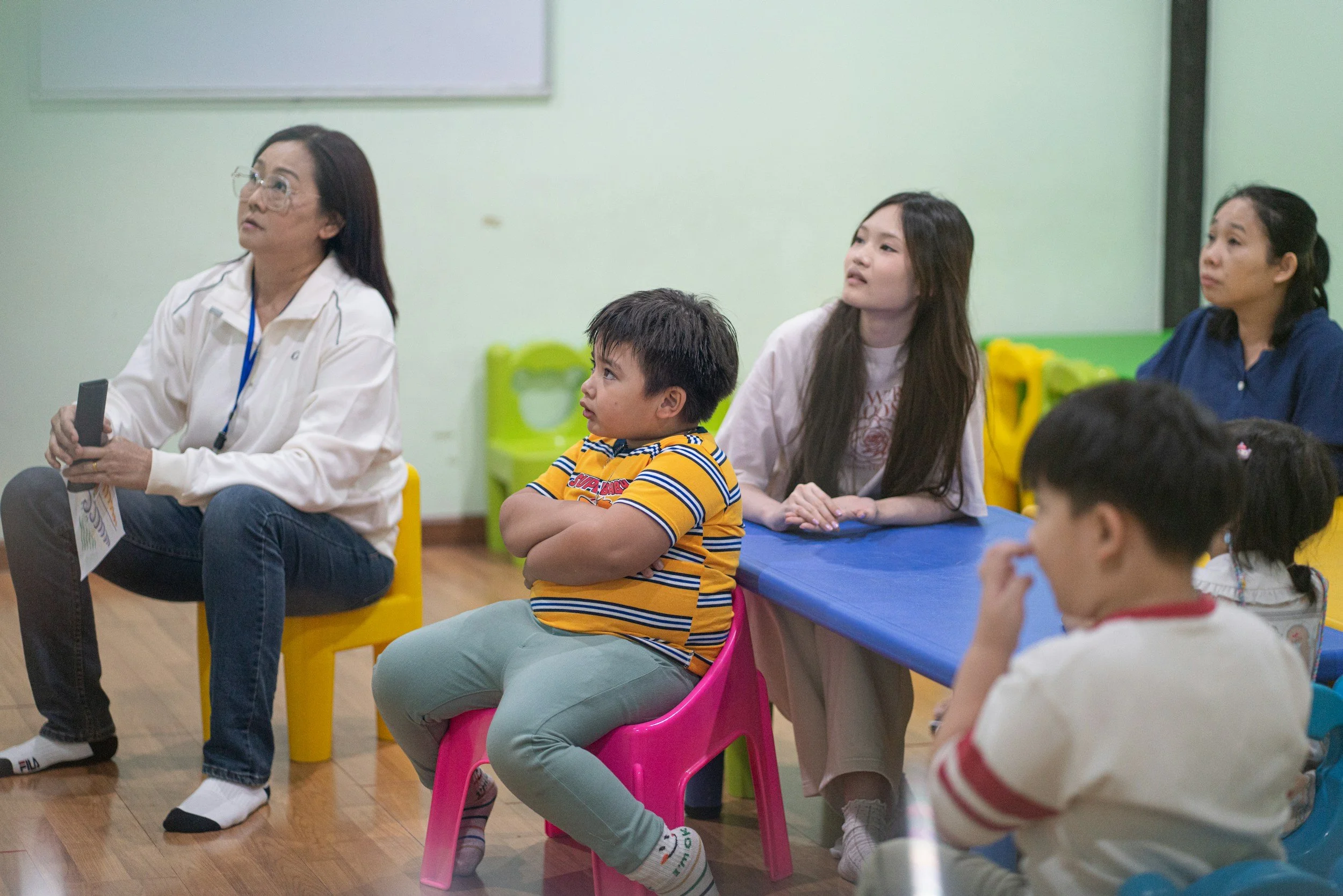
Fine motor skills are the small, coordinated movements of the hands, fingers and wrists that children rely on for writing, drawing, cutting, dressing and feeding themselves. If a child past the age of five still writes with a whole-fist grip, tires after a few minutes of handwriting, or avoids drawing and cutting altogether, the recommended next step is a paediatric occupational therapy assessment. For families in Dubai, specialist assessment and therapy for children are available at Bloom Beyond Enabling in Al Jaddaf.
Most parents notice the problem in ordinary moments rather than dramatic ones. Your child grips a crayon in a whole fist at an age when their classmates have moved on to a neat three-finger hold. Buttons defeat them every morning. Scissors are held upside down and abandoned in frustration. Handwriting comes out large, uneven and effortful, and homework that should take ten minutes stretches into an hour of tears.
These skills are easy to overlook because nobody celebrates them the way they celebrate a first step. But when they lag behind, the effects reach into schoolwork, independence and self-esteem — and they respond very well to the right support.
Fine motor control does not begin in the fingers. It builds outward from the centre of the body, a principle occupational therapists call proximal-to-distal development. A child needs a stable trunk before they can control their shoulder. They need a stable shoulder before they can control the elbow and wrist. Only then can the small muscles of the hand do delicate, isolated work.
This explains something that surprises many parents: a child who slumps at the table, wraps their legs around the chair or props their head on one hand is often not being lazy. They are borrowing effort from their core, leaving less available for their hands.
Rough developmental expectations look something like this. By around two, most children scribble and stack a few blocks. By three, they begin to copy simple shapes and use a more mature grasp. By four, they usually manage scissors on a straight line and draw a recognisable person. By five or six, they typically write their name, dress independently and manage most fasteners. Children vary widely, and a few months either side of these markers is unremarkable. A consistent gap across several areas is worth investigating.
Individually, most of the following are within normal variation. Together, they form a pattern worth discussing with a professional. Studies estimate that around 5–6% of school-aged children have developmental coordination disorder (dyspraxia), and many more have milder fine motor delays that respond well to early support.
Persistent fist grip or an awkward, cramped pencil hold past the age of five
Pressing far too hard or far too lightly when drawing or writing
Rapid hand fatigue, with complaints of aching after a few minutes of writing
Avoidance of colouring, cutting, threading, construction toys or puzzles
Ongoing difficulty with zips, buttons, laces and cutlery
Frequent dropping of small objects, or clumsiness with everyday tools
Difficulty using both hands together, such as steadying paper while cutting
No clear hand preference established by around five years of age
Letter formation that stays reversed, inconsistent or poorly spaced well into school
The reason for these difficulties varies. It may be low muscle tone, reduced hand strength, immature bilateral coordination, weak visual-motor integration — the link between what the eyes see and what the hands do — or difficulty with proprioception, the body's internal sense of where its parts are and how much force they are exerting.
It would be easy to dismiss neat handwriting as a fading concern in an age of keyboards. That underestimates the problem.
When writing demands most of a child's conscious attention, very little capacity remains for the thing they are writing about. A child may understand a topic thoroughly and still produce a thin, disappointing piece of work, because the physical act consumed the effort. Teachers can misread this as inattention or low ability.
There is a social dimension too. A child who cannot fasten their own shoes or open their lunchbox notices that their peers can. Independence is closely tied to confidence, and children are acutely aware of the gap. Many of the behaviours parents describe as “refusing” or “being difficult” around table work are, on closer inspection, avoidance of something that genuinely hurts or embarrasses them.
Occupational therapy looks past the pencil to the whole system supporting it. An assessment typically examines posture and core stability, shoulder and hand strength, grasp patterns, coordination between the two sides of the body, visual-motor skills and sensory processing. The goal is to identify the underlying reason rather than to drill the visible symptom.
Intervention then works at that level. A child with poor core stability may spend part of a session on climbing, animal walks or work on their tummy before any writing tool appears. A child with weak hand strength may use theraputty, tongs, clothes pegs and spray bottles. A child with visual-motor difficulties may work through mazes, copying tasks and construction activities.
Crucially, sessions are structured as play. Children practise willingly when the activity is enjoyable, and repetition is what builds motor patterns. A skilled therapist also adjusts the environment — pencil grips, slanted writing surfaces, adapted scissors, appropriate chair and table height — so the child can succeed while the underlying skills develop.
Progress is usually gradual but visible. Families often report improvements in dressing and mealtimes before they see changes in handwriting, which is normal, since those tasks make lighter demands on precision.
Fine motor development thrives on ordinary activity rather than worksheets.
Encourage play dough, LEGO, threading beads, jigsaw puzzles, cutting old magazines, and picking up small objects with tweezers. Let your child help with cooking — stirring, kneading, peeling and pouring are excellent practice. Vertical surfaces are particularly valuable: drawing on paper taped to a wall or an easel builds shoulder stability and wrist extension at the same time.
Weight-bearing play matters more than it appears to. Crawling games, wheelbarrow walks, monkey bars and climbing frames all strengthen the shoulder girdle that hands depend on. In the UAE's summer heat, indoor soft play and pool time serve this purpose well through the hotter months.
Finally, keep sessions short and positive. Ten focused, cheerful minutes achieve considerably more than forty minutes of resistance.
Is a fist grip normal at four years old?
Yes, a fist grip is still common at four, but it usually matures into a tripod grasp by around five. Persistence beyond that, particularly alongside fatigue or avoidance, is worth assessing.
Could my child simply be left-handed and struggling?
Possibly. Left-handed children face genuine practical challenges, such as smudging and right-handed scissors. These are usually solved with correct positioning and adapted tools rather than therapy.
Does a fine motor delay mean my child has a learning difficulty?
Not necessarily. Fine motor difficulties can occur on their own, or alongside conditions such as developmental coordination disorder (dyspraxia), ADHD or autism. An assessment clarifies which applies.
How long does occupational therapy take to work?
Most families notice meaningful change within three to six months of consistent weekly occupational therapy sessions combined with home practice, though this depends on the child and the goals set.
Where can my child get an occupational therapy assessment in Dubai?
Bloom Beyond Enabling provides paediatric occupational therapy and sensory integration assessments at its centre in Al Nastaran Tower, Al Jaddaf Waterfront, serving families across Dubai and the wider UAE.
Should we wait to see if they grow out of it?
Waiting is usually the wrong default. Some children do catch up, but the years when handwriting demands increase sharply are also the years when frustration takes root, and early support is generally easier than remediation later.
If you recognise your child in this article, an occupational therapy assessment offers a clear picture of what is happening and a practical plan to address it.
Bloom Beyond Enabling provides occupational therapy and sensory integration, speech and language therapy, ABA therapy and clinical psychology for children and families across Dubai and the wider UAE. To arrange an assessment or ask a question, call +971 4 554 5234 or +971 52 600 4107, email bloom@bloombeyond.me, or visit us at 601, 602 & 701 Al Nastaran Tower, Al Jaddaf Waterfront, Dubai.



.png)

.png)

.png)
.png)
.png)
.png)