Play skills are the social, communication and imaginative abilities children use to interact with one another, and they develop in predictable stages rather than all at once. If your child plays happily alongside other children but not with them, that is typical up to around age three; beyond that, ongoing difficulty joining in or taking turns is worth having assessed. The recommended next step is a developmental assessment with a speech and language therapist, occupational therapist or behaviour therapist. Support of this kind is available at Bloom Beyond Enabling in Al Jaddaf, Dubai.
Few things worry parents more than watching their child hover at the edge of a group while everyone else swaps toys and invents games. It is a common concern among families in Dubai, and it deserves a careful answer rather than a reassuring shrug.
Play is not a break from learning — it is how young children rehearse language, negotiation, emotional regulation and problem-solving. When play is difficult, the difficulty is rarely about being "shy" or "naughty". It usually points to a specific skill that has not yet come online, and those skills can almost always be taught.
Developmental researchers describe social play as a sequence of overlapping stages, which makes it easier to judge whether your child is behind or simply on their own timetable.
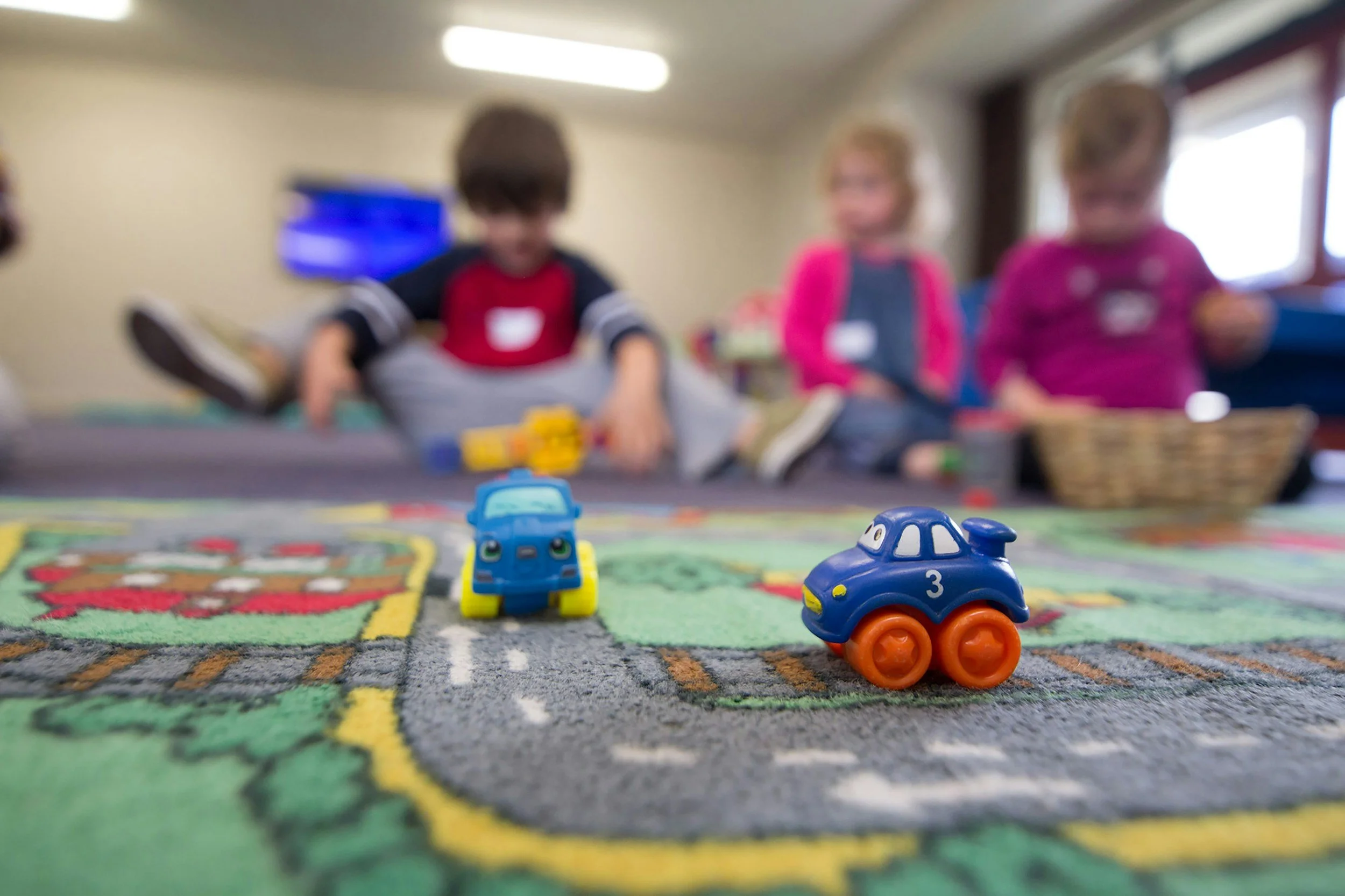
Solitary play dominates the first two years, when your child is absorbed in their own activity and largely unaware of other children. Onlooker play follows at around two: a child watches others intently but does not join in. Parallel play — two children playing side by side with similar toys but no real exchange — is the hallmark of the toddler years and is entirely healthy at two and three.
From around three, associative play appears, with children sharing materials and chatting while each still pursues their own agenda. True cooperative play, in which children agree a shared goal, assign roles and sustain an imaginary scenario together, typically emerges from about four. A five-year-old who has not reached associative play is worth a closer look.
Social play sits at the intersection of several different abilities, which is why so many profiles can disrupt it.
Language delay is the most common culprit: a child who cannot yet ask "can I play?" or follow a fast-moving verbal game will often withdraw rather than risk confusion. Sensory processing differences are another frequent factor — a noisy playgroup can feel genuinely overwhelming to a child whose nervous system registers sound, touch and movement more intensely than most, and stepping away is a sensible act of self-protection.
Difficulty reading social cues makes group play unpredictable and exhausting, and motor planning difficulties can leave a child unable to keep up with running or catching games. Anxiety can lock a capable child out of situations they secretly want to be part of. Some children who are misread as aggressive are simply grabbing a toy because they lack the words to request it. And for some, reduced social interest is one of several signs of autism; recent international estimates suggest around 1 in 31 children is identified with autism spectrum disorder, so it is far from rare — though it is only one of many possible explanations.
Trust your instincts, and act on them sooner rather than later. It is reasonable to arrange an assessment if, by around age three, your child shows little interest in other children or does not imitate their actions; if by four they are not engaging in any pretend or role-play; if group settings routinely end in distress; or if nursery staff have raised concerns of their own.
Early support is consistently more effective than waiting, because these skills build on one another. Families across the UAE have good access to multidisciplinary assessment, and a first appointment at a Dubai clinic usually involves observing your child at play and gathering a developmental history.
ABA and behaviour therapy breaks social interaction into teachable components — requesting, joining, turn-taking, tolerating a peer's choice — builds them systematically, then generalises them into real playgroups rather than leaving them in the therapy room.
Speech and language therapy targets the pragmatic side of communication: initiating a conversation, repairing a misunderstanding, reading tone and body language, and the narrative language that makes pretend play possible. Occupational therapy addresses the sensory and motor foundations, helping a child stay regulated in a stimulating environment. Where anxiety or emotional regulation is the main barrier, clinical psychology offers structured strategies for the child and coaching for parents. Many children in Dubai benefit from two of these working together, with one shared set of goals rather than separate plans.
Start smaller than feels necessary. One well-matched playmate for thirty minutes will teach more than a birthday party for twenty, and choosing an activity your child already loves means the only new demand is the social one.
Use structured games with obvious turns — simple board games, rolling a ball back and forth, building a tower one brick each — because they make turn-taking visible rather than something a child must infer. Narrate what the other child is doing and feeling. Rehearse specific phrases in advance: "Can I play?", "My turn next", "I don't like that." Above all, praise the attempt rather than the outcome; a child who tries to join in and gets it slightly wrong has already done the hard part.
Is it normal for a three-year-old to play alone?
Yes. Parallel play, in which children play beside one another rather than together, is developmentally typical at three. What matters is whether your child notices and shows interest in other children.
Does difficulty playing with other children mean my child has autism?
No. Social play difficulties have many possible causes, including language delay, anxiety, sensory sensitivity and ADHD. Reduced social interest is one autism indicator, but should never be read in isolation.
At what age should my child be playing cooperatively with others?
Most children begin genuine cooperative play — shared goals, assigned roles, sustained pretend scenarios — from around four years old. Not reaching this by five is a reasonable trigger for an assessment.
Can speech therapy help with social skills?
Yes. Speech and language therapists work on pragmatic language: initiating interaction, turn-taking in conversation, interpreting tone and body language, and the storytelling skills that underpin pretend play.
Should I push my child to join in?
Gently encourage, but do not force. Pressure in an overwhelming setting tends to increase avoidance; building the skill in a calm, low-demand situation first is far more effective.
Where can my child get social skills therapy in Dubai?
Bloom Beyond Enabling provides speech, occupational, behaviour and psychology services at 601, 602 & 701 Al Nastaran Tower, Al Jaddaf Waterfront, Dubai, with assessment and therapy available under one roof.
If you recognise your child in any of this, the most useful step is to stop wondering and find out. Our multidisciplinary team provides speech therapy, occupational therapy, ABA and behaviour therapy and clinical psychology for children across Dubai, and can tell you clearly whether support is needed and what it would involve. To arrange an assessment, call +971 4 554 5234 or +971 52 600 4107, email bloom@bloombeyond.me, or visit us at 601, 602 & 701 Al Nastaran Tower, Al Jaddaf Waterfront, Dubai.



.png)

.png)

.png)
.png)
.png)
.png)