
When Numbers Don’t Add Up: Understanding Dyscalculia in Children
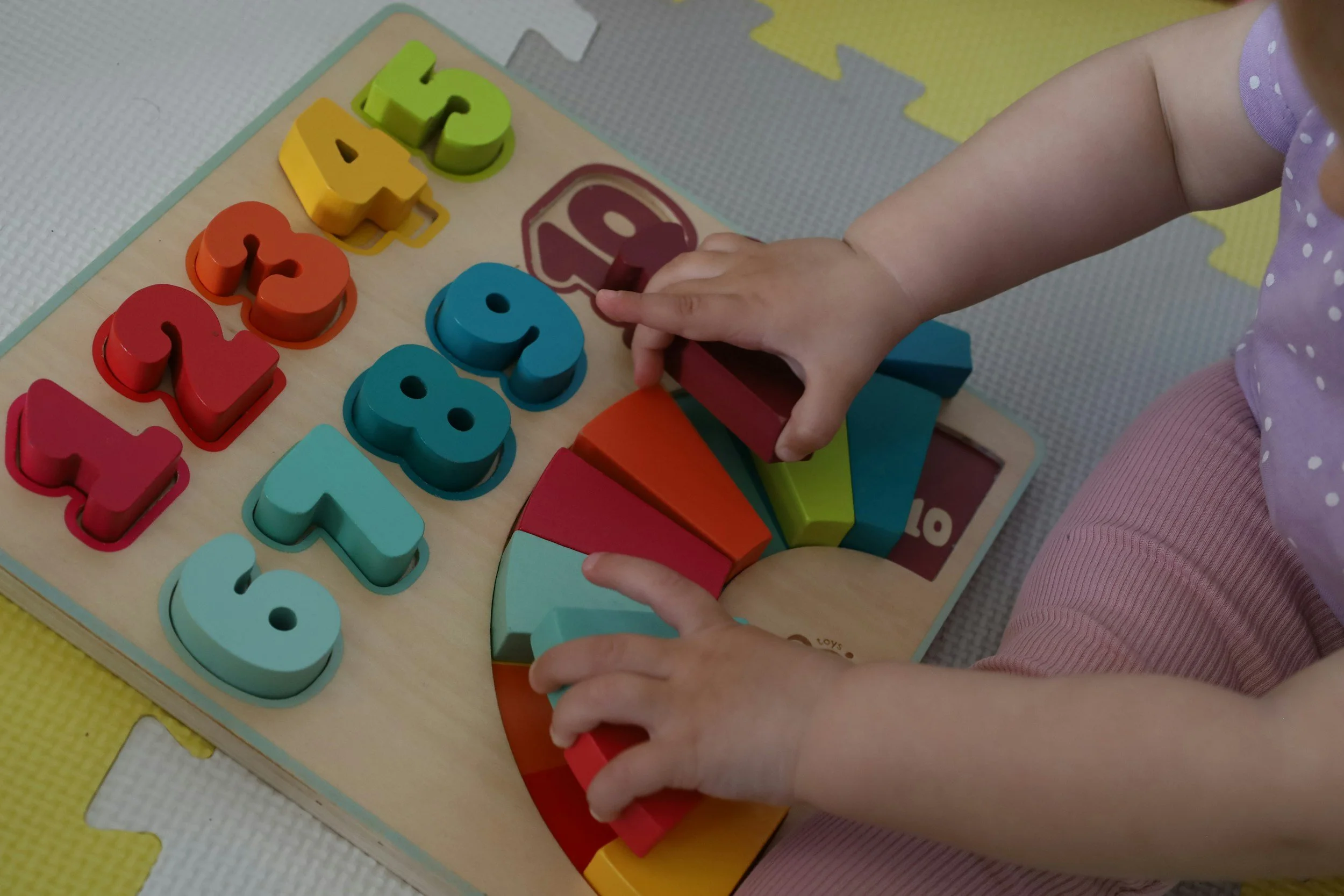
Dyscalculia is a specific learning difficulty that affects how a child understands numbers, quantity and mathematical reasoning — it has nothing to do with intelligence or effort. Children with dyscalculia often count on their fingers long after their classmates have stopped, confuse similar-looking digits, and lose track of the steps in a simple sum. The recommended next step is a psychoeducational assessment, which pinpoints exactly where the difficulty sits and leads to a targeted learning plan. Assessment and ongoing support are available through clinical psychology services at Bloom Beyond Enabling in Al Jaddaf, Dubai.
Most parents in Dubai know the feeling of sitting beside a child at the kitchen table while homework quietly turns into tears. For many families it is a passing phase. But when maths in particular becomes a daily battle — when a child who reads beautifully cannot remember that seven comes after six, or works out four plus three on their fingers every single time — something more specific may be going on.
Dyscalculia is far less widely recognised than dyslexia, and that lack of recognition is precisely the problem. Children are often described as careless, distracted or simply "not a maths person" for years before anyone considers that their brain processes number information differently. Understanding what dyscalculia actually is, and what help exists locally, changes that story considerably.
What dyscalculia actually is
Dyscalculia is a specific learning difficulty affecting number sense — the intuitive grasp of quantity that most children develop before they ever enter a classroom. A typically developing four-year-old can glance at three biscuits and know there are three without counting. A child with dyscalculia may not have that instant sense of "how many", and so has to count everything, every time.
Because number sense underpins everything that follows, the difficulty compounds. Learning times tables, estimating whether an answer is reasonable, telling the time, handling money and following multi-step calculations all rest on a foundation that was never securely built. Studies estimate that around 3–7% of school-aged children have dyscalculia, placing it at a similar prevalence to dyslexia — roughly one or two children in an average Dubai classroom.
Importantly, dyscalculia is not the same as maths anxiety, although the two frequently travel together. A child may develop real anxiety about maths lessons as a result of repeated failure, and that anxiety then makes performance worse still.
Signs of dyscalculia at different ages
In the early years (3–6): difficulty learning to count in sequence, little sense of which of two groups is "more", trouble recognising written digits, and struggling to connect the numeral 5 with five objects.
In primary school (6–11): persistent finger counting, difficulty memorising number facts and times tables despite hours of practice, confusion between symbols such as + and ×, trouble with place value, difficulty telling the time on an analogue clock, and taking noticeably longer than peers on written work.
In older children (11+): difficulty estimating, a poor grasp of money and budgeting, avoiding situations involving numbers, trouble with measurement, and struggling to follow multi-step problems even when each individual step is understood.
A single sign proves nothing — most children find some part of maths hard at some point. The pattern that matters is persistence, severity, and the gap between a child's maths ability and their ability in every other subject.
What causes dyscalculia — and what does not
Dyscalculia is neurological in origin. Research points to differences in the parietal lobe, the region involved in processing quantity and spatial relationships. It tends to run in families, and it often sits alongside other neurodevelopmental profiles: many children with dyscalculia also have attention difficulties, dyslexia, or coordination difficulties.
What does not cause dyscalculia is poor teaching, insufficient practice, laziness, or a lack of parental involvement. This matters, because the wrong explanation leads to the wrong response — more drilling, more worksheets, more frustration — when what the child actually needs is a different route into the concept. Families across Dubai and the wider UAE often spend a year or more on extra tutoring before an assessment is ever considered.
How dyscalculia is assessed in Dubai
Assessment begins with a detailed developmental and educational history, followed by standardised testing that separates maths ability from general cognitive ability, reading, working memory and attention. That separation is the entire point: it establishes whether the maths difficulty is specific, or part of a broader picture.
At our centre in Al Jaddaf, assessment is carried out by a clinical psychologist, who will also screen for the co-occurring difficulties described above. Where visual-motor, spatial or handwriting difficulties appear alongside the number difficulties, an occupational therapy assessment is often recommended in parallel. If a child also struggles to follow verbal instructions or to hold multi-step language in mind, input from speech and language therapy may be relevant.
The output is not a label for its own sake. It is a report the school can act on, setting out the accommodations a child is entitled to and the specific teaching approaches most likely to work.
Support that genuinely helps
Effective intervention for dyscalculia is concrete, multisensory and slow in the best sense. Rather than repeating the same explanation more loudly, it rebuilds number sense from the ground up using physical materials — counters, number rods, ten frames — so that quantity becomes something a child can see and hold before it becomes something abstract on a page.
Alongside this, schools in Dubai can put reasonable accommodations in place: extra time, permission to use a calculator or multiplication grid, reduced question volume, and marking that credits method rather than only the final answer. Where maths anxiety, avoidance or low self-esteem have taken hold, psychological support helps a child separate their worth from their maths marks, and structured behavioural strategies can rebuild a willingness to attempt tasks at all.
What parents can do at home
Keep practice short and frequent rather than long and exhausting — ten focused minutes beats an hour of attrition. Use real contexts: cooking, shopping, counting out dirhams, measuring for a craft project. Numbers attached to something tangible are far easier to hold on to than numbers on a worksheet.
Resist correcting immediately. Let your child explain how they arrived at an answer, because the explanation reveals exactly where the reasoning breaks down. And be careful about the language used around maths at home: "I was terrible at maths too" is meant kindly, but it quietly tells a child that the difficulty is fixed and inherited.
Finally, talk to the school early. A child who is quietly falling behind in Year 3 is far easier to support than a teenager who has spent six years concluding that they are simply not clever.
Frequently asked questions
Is dyscalculia the same as just being bad at maths?
No. Most children who find maths hard improve steadily with good teaching and practice, whereas dyscalculia is a persistent difficulty with number sense itself that remains despite appropriate teaching. The distinguishing feature is the gap between a child's maths ability and everything else they can do well.
At what age can dyscalculia be identified?
Reliable assessment is usually possible from around seven years of age, once a child has had enough formal maths teaching for a specific difficulty to be distinguished from normal variation. Concerns raised before that age are still worth acting on, because early support builds number sense while it is most malleable.
Can a child have dyscalculia and dyslexia at the same time?
Yes — the two co-occur in a substantial proportion of cases, and dyscalculia also commonly appears alongside ADHD and coordination difficulties. This is one of the main reasons a proper assessment looks well beyond maths alone.
Will my child grow out of dyscalculia?
No. Dyscalculia is a lifelong difference in how the brain processes number information. With the right teaching, accommodations and compensatory strategies, however, children learn to manage it well and go on to succeed academically and professionally.
Does an assessment report actually help at school?
Yes. A formal report gives schools in Dubai the documented evidence they need to put accommodations in place, and it shifts the conversation from effort and attitude to teaching method, which is where it belongs.
Where can my child get a dyscalculia assessment in Dubai?
Assessments are available at Bloom Beyond Enabling, 601, 602 & 701 Al Nastaran Tower, Al Jaddaf Waterfront, Dubai. Our clinical psychology team carries out the assessment and then works with your child's school on the recommendations that follow.
If numbers have become a source of daily distress in your home, an assessment is the fastest way to replace guesswork with a plan. Our team provides clinical psychology assessment and support, alongside occupational therapy, speech and language therapy and ABA behaviour therapy. To arrange an assessment, call +971 4 554 5234 or +971 52 600 4107, email bloom@bloombeyond.me, or visit us at 601, 602 & 701 Al Nastaran Tower, Al Jaddaf Waterfront, Dubai.
