Most parents expect their child to find maths tricky from time to time. But for some children, numbers never quite seem to make sense — counting feels effortful, simple sums are guessed rather than solved, and homework ends in tears night after night. If this sounds familiar, your child may be showing signs of dyscalculia, a specific learning difficulty that affects how the brain processes numbers and mathematical concepts. Although less widely known than dyslexia, dyscalculia is thought to affect around five per cent of children, which means most classrooms in Dubai will include at least one child quietly struggling with it. The good news is that with the right identification and support, children with dyscalculia can build confidence and genuine competence with numbers.
Dyscalculia is a specific learning difficulty affecting a person's ability to understand, remember and work with numbers. It is not caused by low intelligence, poor teaching or lack of effort. Children with dyscalculia often have an underdeveloped sense of number magnitude — the intuitive feel for "how much" a number represents. Where most children quickly grasp that seven is bigger than four without counting, a child with dyscalculia may need to work this out each time.
This core difficulty ripples outward. Learning number bonds, telling the time, handling money, remembering times tables and estimating quantities all become far harder than they should be. Importantly, dyscalculia is a lifelong difference in how the brain works, but its impact can be dramatically reduced with structured, well-targeted support.
In the early years, you might notice difficulty counting objects accurately, trouble recognising small quantities at a glance, or confusion matching a number symbol to an amount. A child may count "one, two, three" fluently in sequence yet be unable to hand you three blocks.
In primary school, warning signs become clearer. Children may rely on finger counting long after their peers have moved on, struggle to remember basic number facts, confuse mathematical symbols, or find word problems overwhelming. Telling the time on an analogue clock is often a persistent challenge, as is understanding money — a practical concern for families used to handling dirhams at the supermarket.
Emotionally, many children develop maths anxiety: a genuine dread of anything involving numbers. They may describe themselves as "stupid" or refuse to attempt work, when in fact their difficulty is specific, identifiable and supportable.
Many children have gaps in their maths knowledge from missed schooling, frequent school moves — common among expatriate families in the UAE — or teaching approaches that did not suit them. These gaps usually close with good tuition. Dyscalculia is different: the difficulty is persistent, appears out of proportion to the child's other abilities, and does not resolve with ordinary extra practice.
A child who reads fluently, reasons well and expresses sophisticated ideas verbally, yet cannot reliably recall that six plus three makes nine, presents a profile worth investigating. A formal assessment by a qualified professional can distinguish dyscalculia from general difficulty, and can also identify co-occurring conditions such as ADHD, dyslexia or working memory weaknesses, which frequently appear alongside it.
A psycho-educational assessment typically involves a detailed developmental history, standardised tests of mathematical ability, and measures of underlying skills such as working memory, processing speed and reasoning. The aim is not simply a label, but a clear map of your child's strengths and needs that teachers and therapists can act upon.
For families in Dubai, an assessment report also supports conversations with schools about classroom accommodations — extra time, access to number lines or multiplication grids, and modified homework expectations — which can transform a child's daily experience almost immediately.
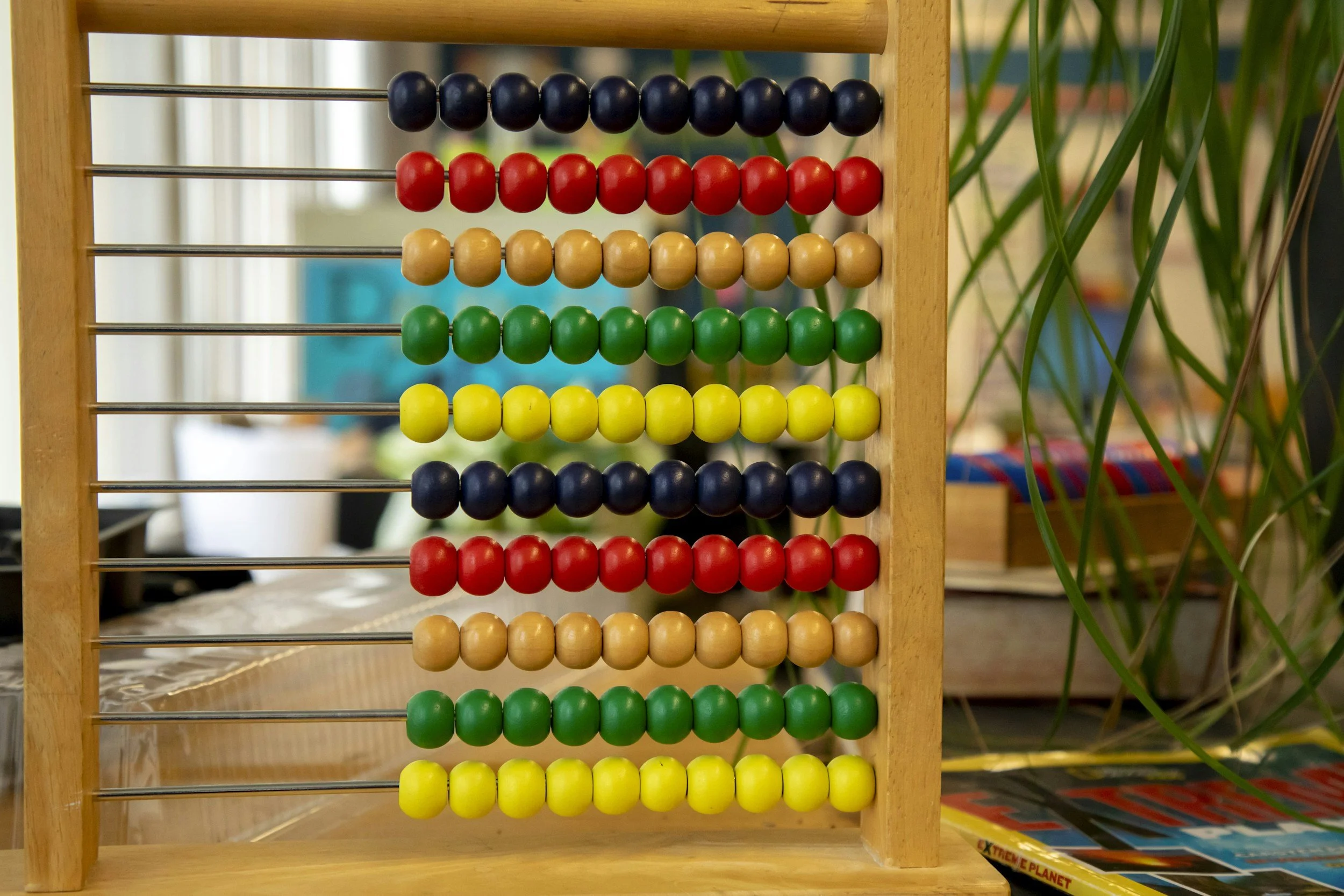
Effective support for dyscalculia is structured, multisensory and cumulative. Children learn best when abstract numbers are anchored to concrete materials: counters, base-ten blocks, number rods and visual models that make quantity visible and touchable. Skills are taught in small, logical steps, with plenty of successful repetition before moving on.
At home, parents can weave numbers into daily life without pressure. Let your child pay at the till and count the change, halve a recipe together, keep score in family games, or estimate how many dates are left in the box. Short, frequent, playful practice builds far more than lengthy, tearful homework sessions. Praise effort and strategy — "you checked it on the number line, well done" — rather than speed or correct answers alone.
Occupational therapy and educational psychology input can also help where difficulties with working memory, attention or anxiety are part of the picture, ensuring your child is supported as a whole person rather than a set of test scores.
Perhaps the most important intervention of all is protecting your child's self-belief. Children with dyscalculia are at real risk of deciding early that they are "not clever", a belief that can shadow them long after school. Talk openly and positively about learning differences. Remind your child of everything they do well. Celebrate progress in maths however small, and make sure they know that needing a different route to understanding is not the same as being unable to learn.
Is dyscalculia the same as being bad at maths?
No. Many people find maths hard for many reasons. Dyscalculia is a specific, persistent difficulty with number sense itself, present from early childhood and out of step with a child's other abilities.
At what age can dyscalculia be assessed?
Concerns can be explored from around age six, once formal number learning has begun. Earlier than this, professionals can still assess development and begin support without a formal diagnosis.
Can children with dyscalculia succeed at school?
Absolutely. With appropriate teaching methods, classroom accommodations and support for confidence, children with dyscalculia progress well and go on to thrive in a wide range of careers.
Does dyscalculia occur with other conditions?
Yes, it commonly co-occurs with dyslexia, ADHD and developmental coordination difficulties, which is why a comprehensive assessment is so valuable.
How can I get my child assessed in Dubai?
A clinical psychology team experienced in learning difficulties can carry out a full psycho-educational assessment and guide you through school support and therapy options in the UAE.
If numbers are a daily battle in your home, you do not have to navigate it alone. Our clinical psychology and therapy team in Al Jaddaf supports children with dyscalculia, ADHD and other learning difficulties through assessment, intervention and close partnership with parents and schools. Call us on +971 52 600 4107, email bloom@bloombeyond.me, or visit us at 601, 602 & 701 Al Nastaran Tower, Al Jaddaf Waterfront, Dubai.



.png)

.png)

.png)
.png)
.png)
.png)